How AI clinical decision support is changing nurse triage: what the evidence shows

AI clinical decision support is changing telephone triage by guiding nurses with adaptive questions, while ensuring the nurse makes every decision. Peer-reviewed research shows AI triage matches protocol-based triage on safety and accuracy, and some national services are already using it successfully at scale, including Healthdirect Australia’s national nurse helpline.
This article explains how AI clinical decision support works, what the evidence shows, and what to look for when choosing AI for your nurse triage line.
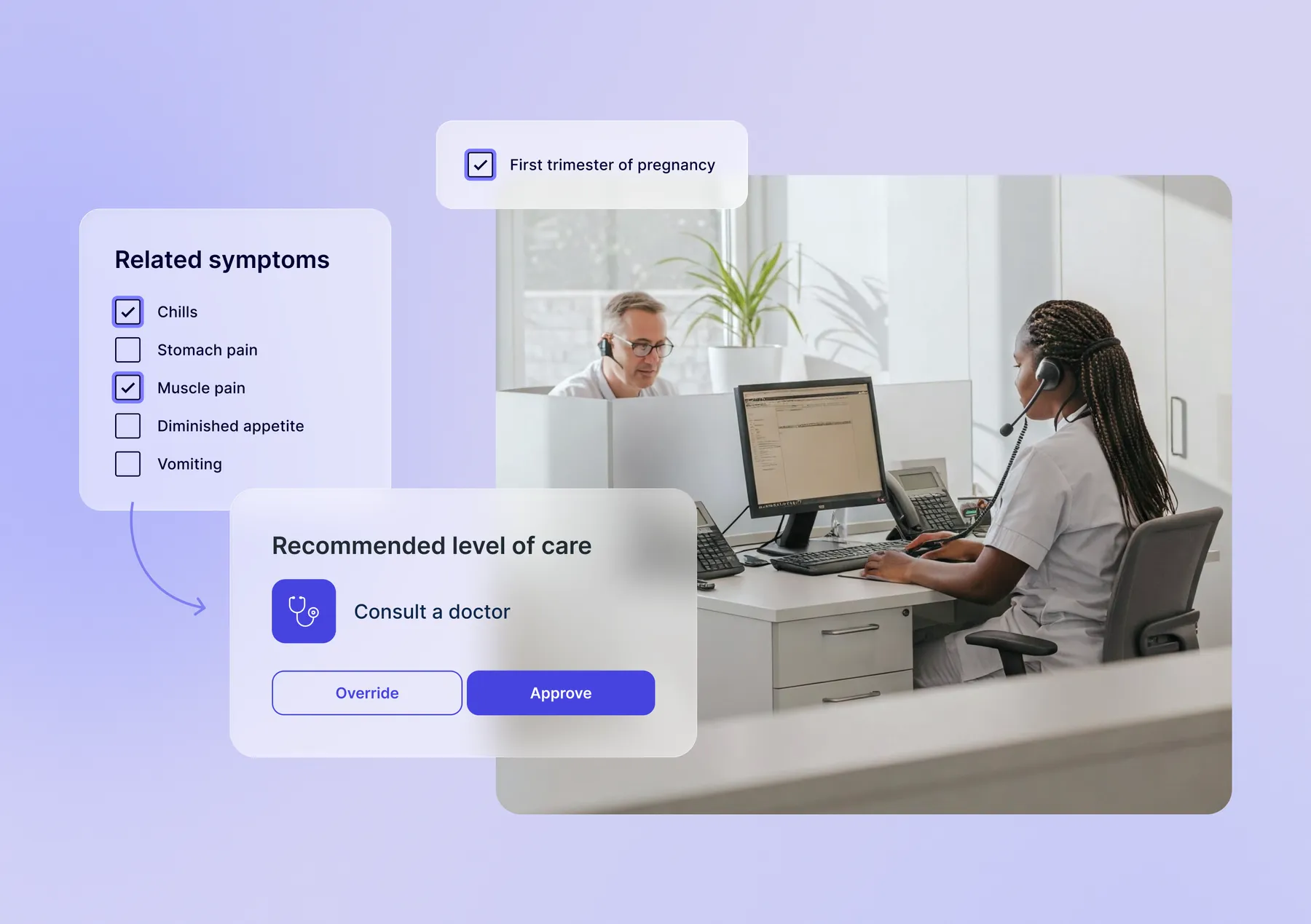
Clinical AI Triage supports nurses in their role of triaging patients, while ensuring nurses remain in control of all clinical decisions.
At a glance:
What is clinical decision support for nurse triage?
Clinical decision support for nurse triage is nurse-facing software for use at non-emergency healthcare advice lines. Clinical decision support structures conversations and guides on-call staff on which questions to ask. In essence, it helps every caller get a consistent, complete assessment while ensuring clinical decision-making stays in the hands of the nurse on the call.
Two approaches prevalent in nurse advice lines globally are rules-based triage protocols and AI-driven clinical support systems.
How does AI clinical decision support differ from protocol-based nurse triage?
Protocol-based nurse triage systems are a longstanding and widely used approach in many public and private healthcare services. The nurse selects a protocol based on the caller’s presenting symptom or clinical concern and follows a structured series of questions, often screening early for signs of potentially life-threatening conditions. The caller’s responses guide the triage decision and recommended level of care.
These systems provide a structured and consistent framework for assessment, with protocols that can be clinically reviewed and applied by trained triage nurses. However, clinical judgement remains important when symptoms are unclear, the presentation does not fit the protocol, or escalation is required.
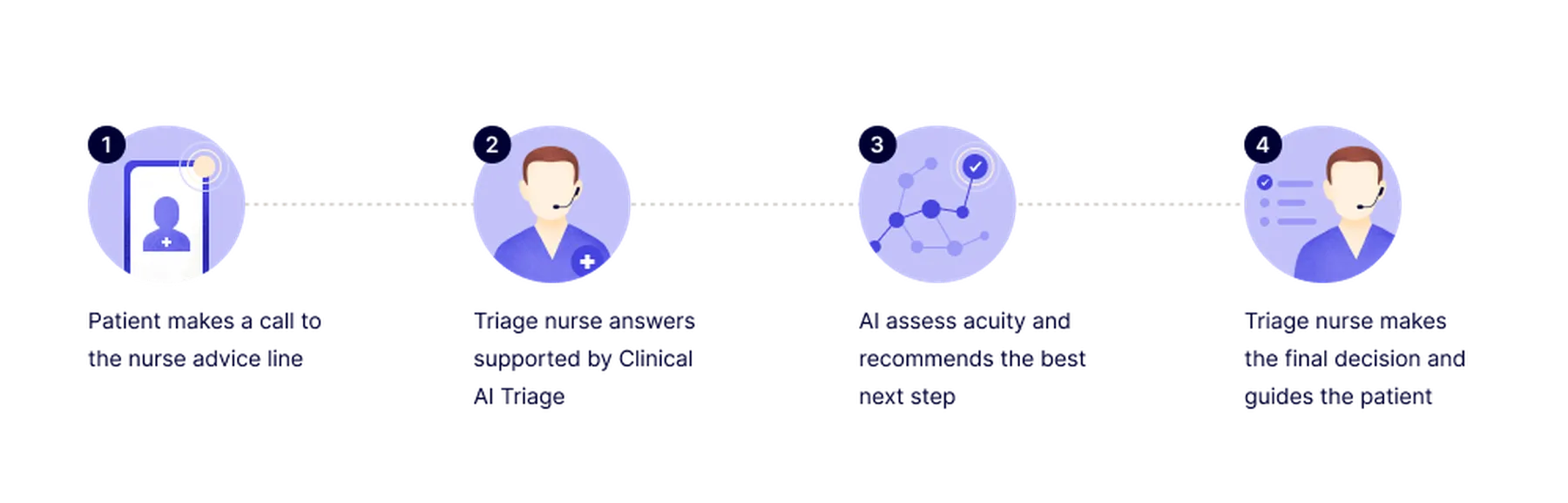
Infermedica's Clinical AI Triage is a nurse-facing tool that supports on-call triage nurses in guiding patients consistently and efficiently to the most appropriate care.
AI-powered clinical decision support takes a more dynamic, evidence-driven approach. Rather than following a fixed sequence of questions, it continuously analyses the caller’s responses, weighing multiple symptoms, risk factors and relevant medical history to determine which question to ask next. This adaptive approach builds a more integrated clinical picture as the interview progresses, helping identify relationships between symptoms, assess competing clinical possibilities and detect potential red flags that might otherwise be overlooked.
Infermedica's Clinical AI Triage applies this approach to nurse advice lines, supporting clinical assessment and care recommendations. Its technology is used by national helpline Healthdirect Australia and Portuguese health insurer Médis.
AI clinical decision support vs. protocol-based nurse triage
In a peer-reviewed comparison, AI triage matched protocol-based telephone triage on safety and accuracy, while also sending fewer non-emergent cases to emergency care and collecting more clinical information from each case.
Researchers tested 149 clinical vignettes, prepared by independent physicians at Western University in Canada. Each case was triaged with Infermedica's AI triage engine and with live telephone triage using Schmitt-Thompson protocols, the gold standard for protocol-based triage in the US.
Equally safe: both approaches reached 91% safety performance, meaning cases were not triaged to a lower level of care than needed.
Comparable accuracy: overall accuracy was 76.5% for AI triage and 71.8% for protocols. AI triage was more accurate for emergency and non-emergent cases, while protocols were more accurate for self-care cases (52.4% vs 38.1%).
Overall, the research shows that AI clinical decision support is as safe as Schmitt-Thompson’s rules-based protocols.
Beyond matching protocols on safety, AI triage performs better than protocols in two areas that matter for nurse advice lines.
AI triage made less overtriage to emergency care: AI triage sent 11.6% of non-emergent cases to emergency care, compared with 26.1% for protocols.
AI triage collected more clinical information: AI triage collected four times as much clinical information as protocols, both at the start of the assessment (4.7 vs 1.2 data fields) and to complete it (9.9 vs 2.1).
It’s worth noting that while the difference in overtriage was not statistically significant in this study, AI triage's ability to lower overtriage is also demonstrated in results from live use at Healthdirect Australia, where overtriage was 46% lower than with the previous system. Read more about this implementation below.
Can AI clinical decision support reduce call volumes and wait times?
AI clinical decision support does not reduce the number of people who call a nurse advice line, but it can help nurses handle each call more efficiently, therefore allowing them to assess more patients per hour and potentially reducing wait times.
Less time per interview: AI clinical decision support can significantly shorten triage interviews. The average interview with Clinical AI Triage takes just 4 minutes 57 seconds compared to 11-20 minutes with Schmitt-Thompson.
How do national health helplines use AI clinical decision support?
National health lines use AI clinical decision support to ensure consistency and efficiency in the guidance that nurses offer. In Australia, Infermedica supports Healthdirect to provide a 24/7 telephone helpline to over 26 million Australians. The impact is tangible and has been published in NEJM AI.
Fewer unnecessary emergency visits: 55% of callers who intended to go to an emergency department were directed to a less acute setting.
Less overtriage: overtriage was 46% lower than with Healthdirect's previous clinical decision support system.
More accurate triage: triage accuracy improved by 9% compared with the previous system.
For a national helpline, lower overtriage means fewer people sent to emergency departments when they don't need to be, which reduces pressure across the wider health system, not just in the call center.

We needed a CDSS (Clinical Decision Support System) that could tolerate and analyze multiple symptoms. We also wanted it to reflect real consultation that considered risk factors such as predisposing factors, chronic history, and travel history. We also wanted something that was next generation that could provide a more comprehensive and accurate triage.
Dr. Nirvana Luckraj
Former Chief Medical Officer, Healthdirect Australia
How do insurers' nurse call centers use AI clinical decision support?
Médis, a health insurer in Portugal, uses Infermedica's AI clinical decision support in its nurse call center triage service. A peer-reviewed study of the service found that AI-supported triage helped members choose a more appropriate level of care.
Members changed intended care setting: 22.8% of members changed the level of care they had intended to seek.
Most changes were to lower-level care: of the members who changed their plans, 62.2% moved to a lower level of care.
After-hours support: one in five interactions took place outside working hours, and 48.4% of those callers were directed to a lower level of care.
What should you look for when choosing a clinical decision support tool?
Peer-reviewed evidence: ask for published studies, ideally with live calls rather than only written cases, and from a setting similar to your own.
Safety performance: check undertriage rates as well as overall accuracy. Undertriage is the most important safety measure.
Regulatory certification: confirm the tool is certified as a medical device in your market, e.g. under the EU Medical Device Regulation.
Nurse control: the nurse should be able to accept or override every recommendation, with a clear route for escalation.
Fit for your population: check that the tool has been validated for the age groups, languages and communities your service supports.
Integration and data security: confirm how the tool connects with your telephone and patient record systems, and which security and privacy standards it meets.
The bottom line
AI clinical decision support gives nurse advice lines a way to make every call consistent and complete, with evidence showing it is as safe as protocol-based triage. Importantly, AI is supporting clinical judgement rather than replacing it, ensuring the nurse makes every decision.
Learn more about Infermedica’s AI clinical decision support for nurse call centers, or read how call centers are optimizing nurse triage with virtual triage.
EN/BL/2026/10/22/1